

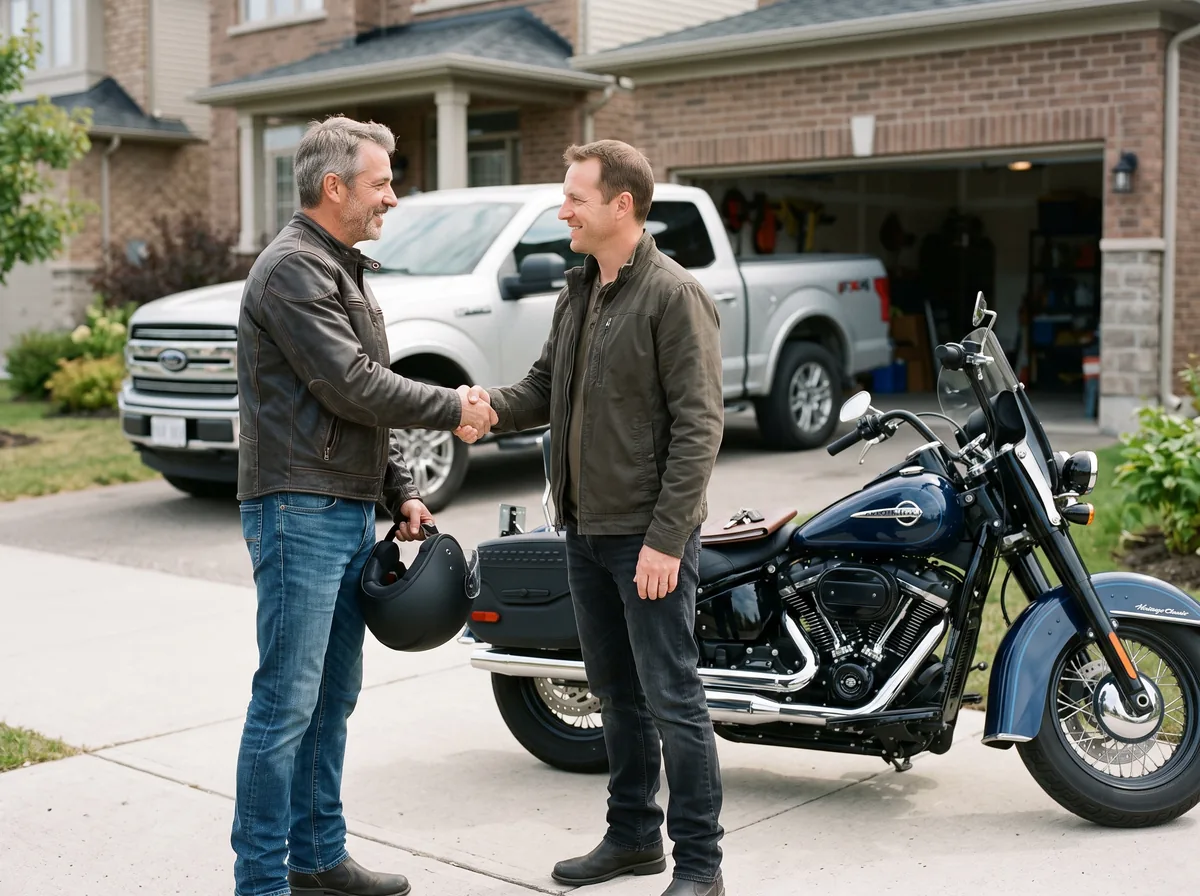
How does transferring motorcycle ownership in Ontario actually work when you sell or buy privately? Short version: the seller buys a Used Vehicle Information Package, both of you sign a bill of sale, the seller keeps the plates, and the buyer has six days to register the bike in their name at ServiceOntario with proof of insurance in hand. That last part trips up more buyers than any other step, so it is worth having a motorcycle insurance quote lined up before the money changes hands.
This is the whole process in order, with the seller’s side first, then the buyer’s, then the mistakes that turn a Saturday handshake into a month of phone calls.
Why the order matters
Transferring motorcycle ownership in Ontario is a paper handoff, and the province has a set order for it. Do the steps out of sequence and you get the classic outcomes: a buyer who cannot register because the seller kept the wrong half of the permit, a seller still legally tied to a bike that left their driveway weeks ago, or a bike that cannot be plated until someone finds a licensed mechanic on a Sunday.
Everything below comes from the province’s own used vehicle page. Where that page is silent, this guide says so and points you to ServiceOntario.
Transferring motorcycle ownership in Ontario: the seller’s steps
You are the one with the legal obligations when transferring motorcycle ownership in Ontario, so start early.
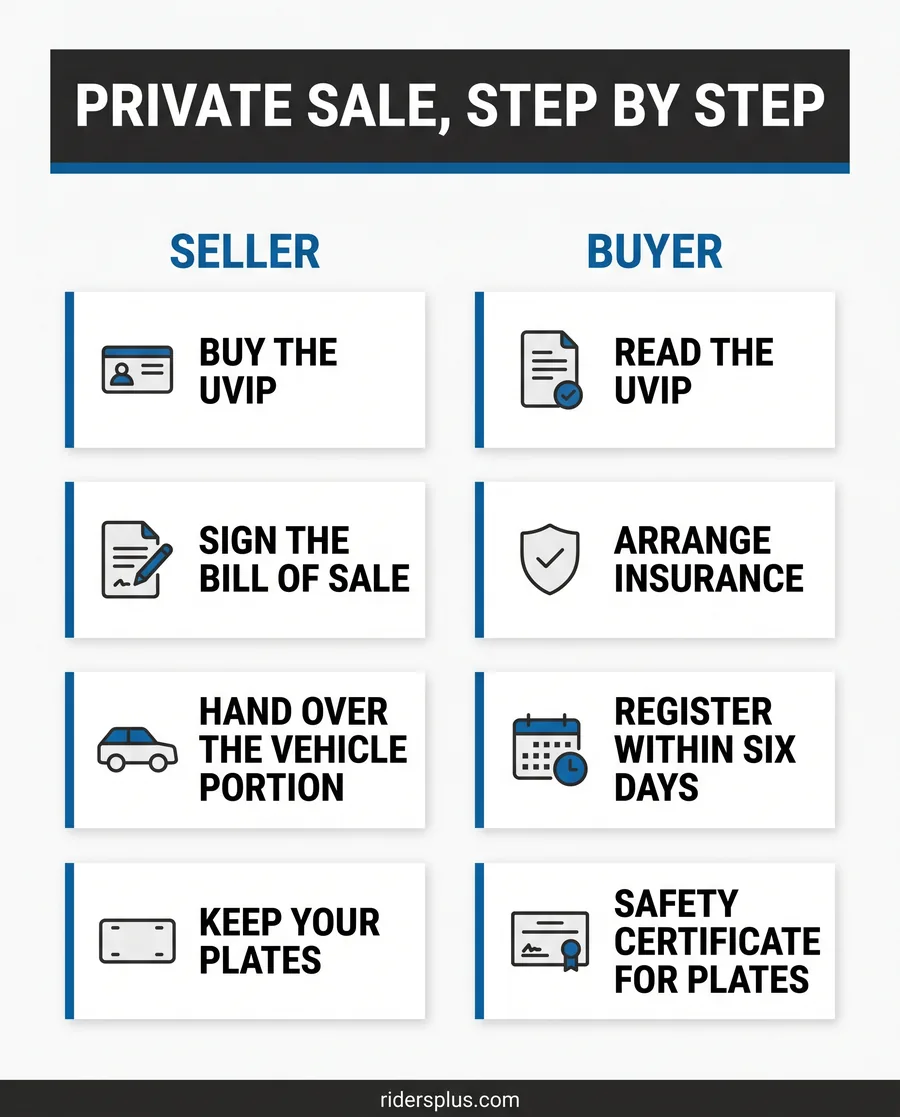
- Buy the Used Vehicle Information Package (UVIP). Ontario requires the seller to give the buyer a UVIP under the Highway Traffic Act. It carries the bike’s registration history, lien information and the retail sales tax details, and it has a bill of sale section at the bottom. Order it online or at a ServiceOntario centre before you list the bike.
- Check the VIN on the bike against your permit. The number on the frame must match your green ownership document. If it does not, stop and sort that out first.
- Confirm there is no money owing on the bike. A lien follows the motorcycle, not the seller, and the UVIP is where a buyer will look for one.
- Complete the bill of sale. The province wants your name, address and signature, the buyer’s name and address, the sale date, and it must be an original document. Handwritten is fine. The bottom of the UVIP works.
- Sign the transfer portion of the permit. The ownership permit has two halves. The vehicle portion goes to the buyer; the plate portion stays with you.
- Keep your plates. In Ontario the plates travel with the driver, not the vehicle. Take them off before the buyer leaves. You can use them on another bike or ask about a refund on any unused validation.
- Give the buyer the paperwork, not the plates. UVIP, signed bill of sale, vehicle portion of the permit, and a Safety Standards Certificate if you have chosen to provide one (more on that below).
One more seller habit that is not on any government page but saves grief: call your broker once the sale is done, so the bike comes off your policy and the plates are ready for whatever comes next.
Pro tip
Photograph every page you hand over, including the signed bill of sale and the buyer’s licence beside it. If a question comes up months later about who owned the bike on a given date, that photo is your answer.
The buyer’s steps
Your side of transferring motorcycle ownership in Ontario starts the moment you pay, and so does your clock.
- Read the UVIP before you pay. Registration history, liens, and whether the VIN matches the bike in front of you. If the seller does not have one, that is your first red flag.
- Get the signed bill of sale and the vehicle portion of the permit. Both signed and dated by both parties.
- Arrange insurance before you go to ServiceOntario. You cannot register the bike without proof of insurance. A Riders Plus broker can set up coverage on a bike you are about to buy so the paperwork is ready the day you need it.
- Register within six days. The province requires the new owner to register the vehicle in their name within six days of purchase. Bring proof of insurance, your Ontario driver’s licence, the UVIP, the bill of sale, and a Safety Standards Certificate if you want plates issued right away.
- Pay the tax and get your permit and plates. Retail sales tax is calculated at ServiceOntario at the time of transfer; how it is worked out depends on the sale and the bike’s wholesale value, so leave the exact figure to the counter.
- Put your plate on and check the sticker rules. Validation requirements change; confirm what applies to motorcycles when you are at the counter.
The Safety Standards Certificate, Explained
A Safety Standards Certificate (SSC) is a document from a licensed Ontario mechanic at a DriveON inspection station confirming the bike met the province’s safety standards on the day it was inspected. When transferring motorcycle ownership in Ontario it is what lets the buyer get plates issued. Without it, a bike can generally still be registered in the new owner’s name, but it cannot be plated and ridden until one is provided.
Who pays for it is a negotiation, not a rule. Sellers often include one to make the bike easier to sell; buyers sometimes prefer to arrange their own so the inspection is done by a shop they trust. Either way, treat the certificate as a snapshot of roadworthiness on one day, not a warranty.
Ask ServiceOntario or the inspection station how long a certificate remains valid for registration purposes, because timing a sale around an expired one is a common way to lose a week.
Common mistakes
- Buying without a UVIP. The seller is required to provide one. If they will not, walk.
- Leaving the plates on the bike. They belong to the seller. A buyer riding on the seller’s plates is riding on someone else’s registration.
- Missing the six-day window. Life gets busy; the deadline does not move.
- Showing up to ServiceOntario without insurance. No proof of insurance, no registration. Sort it the week before.
- A bill of sale with missing details. No date, no address, one signature. The counter will send you back.
- Assuming the SSC means the bike is perfect. It means it passed a safety inspection on one day. Have a mechanic you trust look it over as well, especially on a bike that has been modified in ways that affect insurance.
Red flag
A seller who wants to meet somewhere other than the address on the permit, cannot produce a UVIP, or whose name does not match the ownership document is describing a bike you should not buy. Ontario’s stolen motorcycle numbers are not small; this 2026 theft roundup shows which models move fastest.
When to ask for help
Three situations are worth a call before you sign anything: a bike with a lien on the UVIP, a bike being transferred between family members (the province has separate rules for gifts between family, including the tax treatment), and a bike that has been rebuilt or has a replaced frame. All three are ServiceOntario questions first.
The insurance side is simpler: call before the sale, not after. Trusted by Ontario riders for more than 25 years, Riders Plus sets up coverage on used bikes every week of the riding season, and riders in Kitchener and Waterloo Region or Peterborough and the Kawarthas can reach a broker directly to get proof of insurance ready for the counter.
Good to know
This article is general information, not professional advice. Rules, road conditions, event details and requirements vary and change over time. Confirm anything that matters to you with the relevant authority, and talk to a licensed Riders Plus broker about your own coverage. Riders Plus Insurance is not responsible for decisions made solely on the basis of this article.
Download the free quick guide
A one-page checklist for sellers and buyers: what to gather, what to sign, and what to bring to ServiceOntario.
Frequently asked questions
Can I ride the bike home on the seller’s plates?
No. In Ontario the licence plates stay with the seller, because plates travel with a driver rather than a vehicle. The bike leaves the seller’s driveway without plates, which in practice means a trailer or a truck for the trip home, or arranging a temporary solution through ServiceOntario. Buyers who plan to ride away the same day usually find out about this rule at the worst possible moment, so plan the pickup around it.
What if the seller does not have the ownership permit?
Do not complete the sale until they do. The vehicle portion of the permit is one of the documents you need to register the bike, and a seller without it may not be the registered owner at all. A replacement permit can be obtained through ServiceOntario by the registered owner, so a legitimate seller can fix the gap; a seller who cannot or will not is telling you something.
Do I need insurance before I own the motorcycle?
You need proof of insurance to register the bike in your name, and the province requires that registration within six days of the purchase. So in practice, yes: insurance is arranged for a bike you are about to own, using the VIN from the UVIP. A broker can set this up ahead of the sale date so the documents are ready. It also gives you a real quote for that specific bike before you commit, which is worth knowing before you agree on a price.
Is a Safety Standards Certificate always required?
It is required to have plates issued to the new owner, not to transfer the registration itself. A bike can generally be registered without one and then sit unplated until a certificate is obtained. Who arranges and pays for it is negotiated between buyer and seller. Confirm the current rules and how long a certificate stays valid with ServiceOntario or the inspection station, since both can change.
What to do next
- Seller: order the UVIP today, pull the plates before the bike leaves, and call your broker once it is gone.
- Buyer: read the UVIP, get insurance lined up, and book the ServiceOntario visit inside the six-day window.
- Both: photograph every signed page. Then ride with confidence.





join the conversation