


What does it mean to bundle home, auto and motorcycle insurance in Ontario? In plain terms: you place more than one policy through the same place, and in exchange you usually get one renewal conversation, one person who knows your whole picture, and often a multi-policy discount on some or all of it. The catch, and the reason a motorcycle bundle is different from a plain home-and-auto one, is that a bike is a specialty product that not every insurer writes. Riders Plus places home coverage for Ontario households and auto coverage alongside motorcycle policies every day, so this is a question the brokerage answers a lot.
Here is how the two ways of holding three policies compare, what actually moves the price, and which setup tends to suit which household.
Quick take
Bundling is a way of organizing your insurance, not a product. The savings, when there are savings, come from multi-policy discounts that vary by insurer, and a rider’s bike may sit with a different company than the house and the car even inside a “bundle”. The consistent win is having one broker who sees all three.
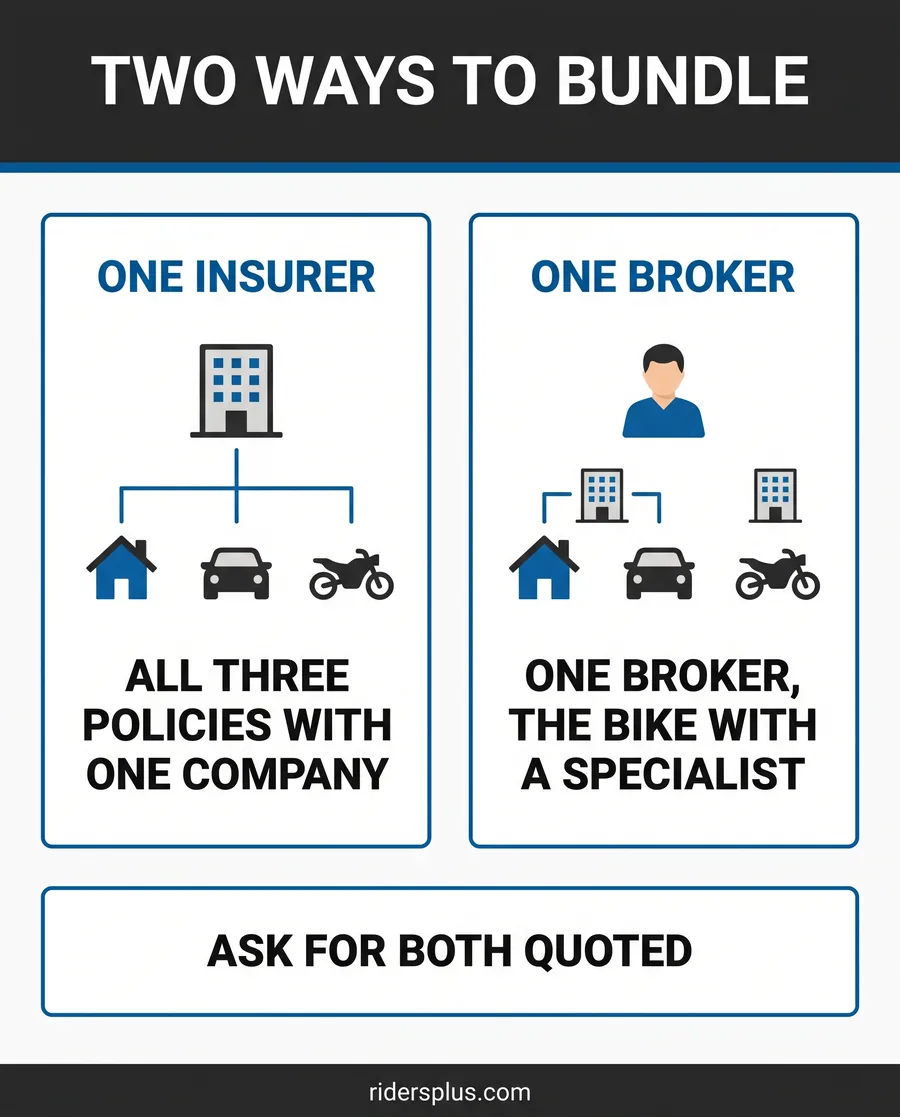
Two ways to hold three policies
One insurer for everything
The version most people picture when they bundle home, auto and motorcycle insurance in Ontario. The house, the car and the bike all sit with a single insurance company, ideally with aligned renewal dates and a multi-policy discount applied across the set. It is clean when it is possible. The limit is that word: FSRA notes that motorcycle insurance is a specialty product and not every company offers it, so the insurer that gives you the best home and auto arrangement may not write bikes at all, or may not write your bike.
One broker, more than one insurer
The version that happens more often for riders. Home and auto go to one company, the motorcycle goes to a company that specializes in bikes, and a single brokerage manages all three. You still get one point of contact and a broker who can see gaps and overlaps across the policies; whether you get a multi-policy discount, and on which policies, depends on what each insurer offers. Riders Plus works this way with home, auto and motorcycle quotes handled by the same team.
Side by side: one insurer or one broker?
| One insurer for all three | One broker, more than one insurer | |
|---|---|---|
| Who you call | One company, one broker | One broker |
| Multi-policy discount | Commonly offered across the set, where available | Depends on each insurer; may apply to some policies and not others |
| Choice of motorcycle insurer | Limited to companies that write bikes | Open; the bike goes where it is placed best |
| Renewal dates | Easier to align | May differ; a broker tracks them |
| Claims | One company’s process | The process of whichever company holds that policy |
| Best when | Your home-and-auto insurer also writes your bike well | Your bike needs a specialist or a better fit |
The takeaway is that the second column is not a consolation prize. For a lot of riders it is the better arrangement, because the bike ends up with a company that actually understands cruisers instead of one that tolerates them.
When you bundle home, auto and motorcycle insurance in Ontario, what actually moves the price
No percentages here, on purpose. Multi-policy discounts exist, they vary by insurer and by which policies are combined, and any number quoted in a blog post would be wrong for most readers by the time they read it. What is fair to describe is the shape of the thing:
- Which policies are combined. Home plus auto is the classic pairing. Adding a motorcycle may or may not attract a further discount, depending on whether the same insurer holds it.
- The bike itself. A cruiser’s value, its modifications, how it is stored and how much it is ridden drive its own premium regardless of what else is in the bundle. Insuring a custom or heavily modified build is its own conversation.
- The rider and the household. Licence class, years riding, claims history and where you live matter for the bike; the same kinds of factors matter for the house and the car.
- Coverage choices. Liability limits, deductibles and optional endorsements move the price on every policy, and a broker looking at all three at once can keep those choices consistent.
The honest summary: bundling can lower the total, and it can also simply make the total easier to manage. Both are worth having. Ask a broker to quote it both ways and compare.
People often ask: if I bundle, does one claim affect all three policies?
A claim is made under the policy that covers the thing that was damaged, and how a claim affects future premiums depends on the insurer and the type of claim. Holding policies together does not automatically mean a motorcycle claim changes your home premium, and it does not mean it cannot. That is a question to ask your broker about your specific insurers, not one with a general answer.
Which setup fits which household
- A homeowner with one car and one cruiser ridden on weekends: the classic case for bundling home, auto and motorcycle insurance in Ontario. Ask for both arrangements quoted. If the home-and-auto insurer writes bikes and the number works, one insurer is simplest; if not, one broker across two insurers is the normal answer.
- A household with two riders and two bikes: the motorcycle side usually leads. Place the bikes well first, then see whether the home and auto follow to the same company or sit elsewhere.
- A rider who rents: tenant coverage, auto and the bike can still be organized through one broker; the discount picture is different, but the one-point-of-contact benefit is the same.
- A rider with a custom build or an unusual bike: the bike will likely need a specialist insurer, which makes the broker-across-insurers arrangement the practical one.

Edge cases: the RV, the second bike, the teenager
Three situations come up often enough to mention. An RV or trailer can usually be folded into the same broker relationship and sometimes the same insurer; ask, because Riders Plus handles RV coverage alongside the rest. A second bike is often simpler than the first, since the specialist insurer already knows you. And a newly licensed driver in the house changes the auto side of the picture more than anything else on this page, which is one reason having a broker who sees all three policies at once pays off at exactly the moment a household gets complicated.
The verdict
To bundle home, auto and motorcycle insurance in Ontario is to put one broker in charge of the whole picture, and sometimes to put one insurer behind it too. The discount is real when it applies, it is never a fixed number, and the bike is the policy most likely to need its own home. Get all three quoted together, both ways, and let the numbers decide.
Riders in Richmond Hill and York Region and Milton and Halton can start with a motorcycle quote request, with home and auto added on or a call to the brokerage. Award-winning motorcycle insurance, and the house and the car looked after by the same people.
Good to know
This article is general information for Ontario riders, not insurance, legal or financial advice, and it does not describe the terms of any policy. Coverage, eligibility and pricing depend on the insurer, the rider and the bike, and they change over time. Talk to a licensed Riders Plus broker about your own situation before you make a decision. Riders Plus Insurance is not responsible for decisions made solely on the basis of this article.
Download the free quick guide
A one-page list of what to ask before you combine home, auto and motorcycle coverage, so both arrangements get quoted properly.
Frequently asked questions
Do I have to bundle home, auto and motorcycle insurance in Ontario with the same company to get a discount?
Not necessarily. Multi-policy discounts are offered by individual insurers and generally apply to the policies that insurer holds, so a home-and-auto discount can exist even when the motorcycle sits with a different, specialist company. Whether a bike adds a further discount depends on whether the same insurer writes it. A broker who quotes the arrangement both ways will show you the difference in real numbers, not in a rule of thumb.
Will bundling make my motorcycle insurance cheaper?
It can, and it can also leave the bike’s premium exactly where it was while lowering the home or auto side instead. A cruiser’s own premium is driven mostly by the bike, the rider and the coverage chosen; bundling changes the picture only where an insurer applies a multi-policy discount to the motorcycle policy specifically. Ask the broker to break the quote down by policy so you can see which line the discount actually lands on.
What happens if I move my bike to a different insurer later?
Usually nothing dramatic. The home and auto policies stay where they are, any discount tied to the bike being with that insurer may fall away, and the broker updates the file. This is one of the quiet advantages of the one-broker arrangement: moving a single policy does not mean starting the whole relationship over. Ask about timing, since aligning the switch with a renewal date generally avoids cancellation charges.
Can I bundle if I rent rather than own?
Yes. Tenant insurance takes the place of a homeowner policy, and it can be organized through the same broker as the auto and motorcycle coverage. The discount picture differs from a homeowner’s, because the policies involved are different, but the practical benefit of one person seeing every policy is identical. Mention the rental situation up front so the broker quotes the right products.





join the conversation