
The Harley-Davidson vs Indian Motorcycle debate never fully goes away, and in 2026 it’s more interesting than it’s been in years. Indian has closed the quality gap significantly over the past decade, Harley has a stronger lineup than it did in 2019, and both companies are competing hard for the same Ontario buyer: an experienced cruiser rider who wants American V-twin character and enough dealer infrastructure to actually keep the bike on the road. This comparison looks at where the two brands actually differ, and where they’re closer than the marketing departments would have you believe.
Beyond cruisers
Both brands have expanded well beyond their cruiser roots. Harley-Davidson offers the Pan America 1250 adventure tourer and has spun off LiveWire as a separate electric motorcycle brand. Indian’s flat-track-inspired FTR 1200 ran through 2024, and the new Sport Scout and 101 Scout target riders who want sportier ergonomics. This article focuses on the cruiser segment, where both companies do their biggest volume and where most Ontario riders are shopping.
Brand identity and community: what you’re buying beyond the bike
With both Harley and Indian, you’re buying into something beyond the machine. The question is which community fits your style of riding.
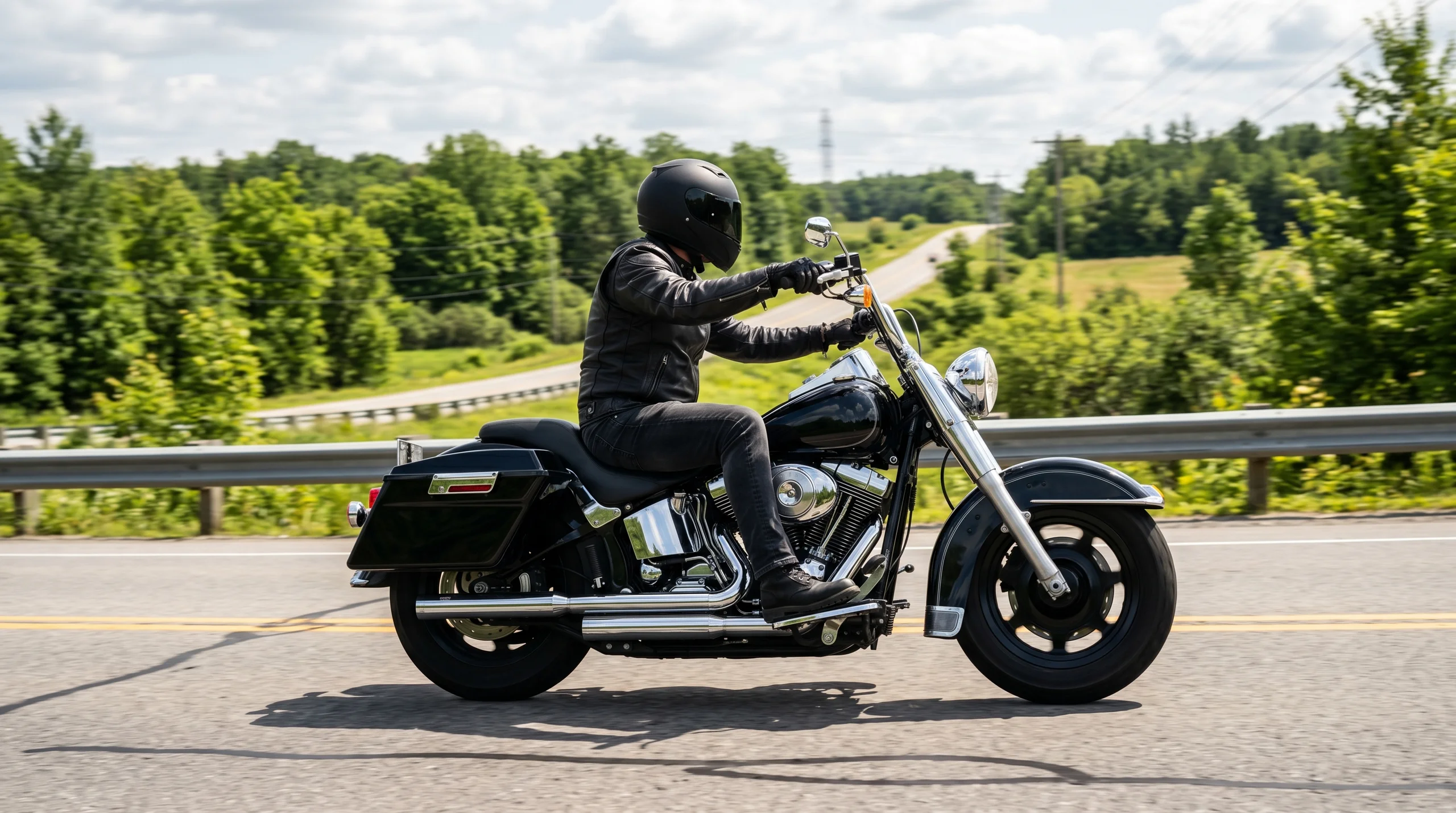
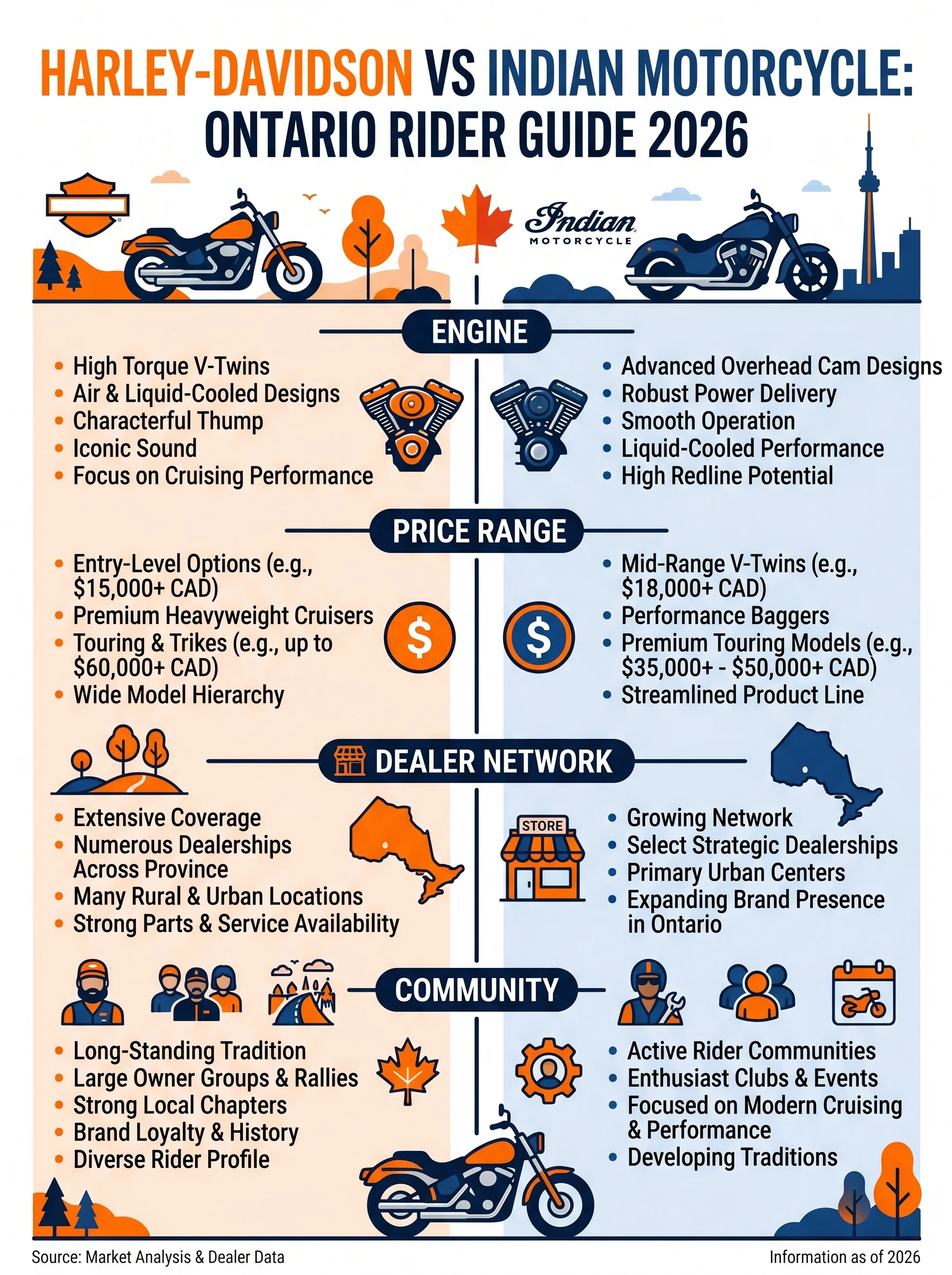
Harley’s HOG (Harley Owners Group) is the larger and more established network in Ontario. Most mid-sized Ontario cities have active chapters, regular rides, and events through the season. If organized group riding matters to you, HOG has the infrastructure.
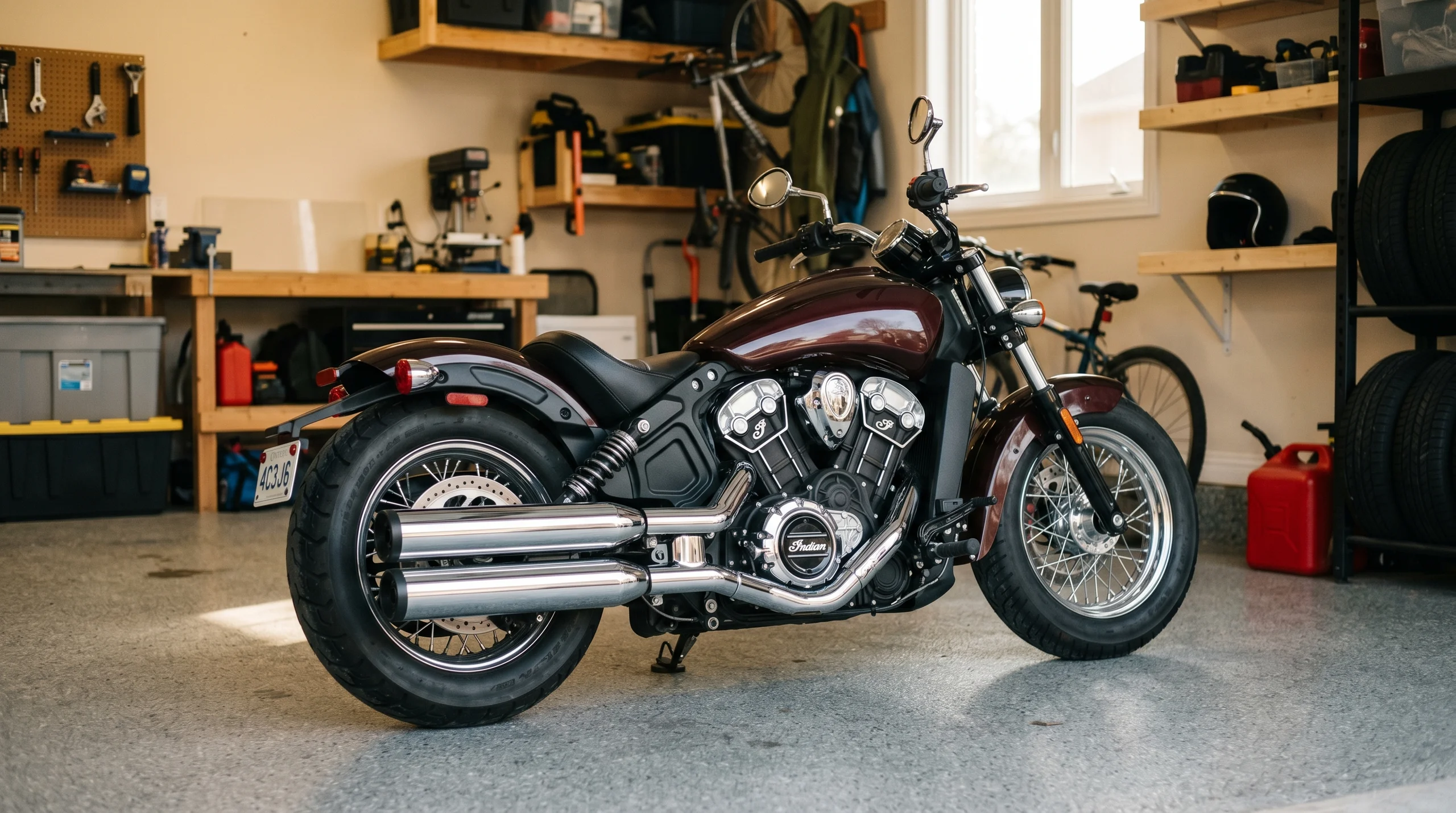
Indian’s Motorcycle Riders Group (IMRG) has grown steadily since the brand’s 2011 relaunch, and Indian dealers in Ontario organize their own events. The community is smaller but enthusiastic, and the brand has a real presence at rallies and events across the province. If you prefer a tighter-knit group, some riders find the Indian side more appealing for exactly that reason.
On resale value, Harley has the longer track record in the Canadian market. Certain models, particularly Road King, Street Glide, and Fat Boy variants, have held value very well over five-year ownership windows. Indian is building a track record, and models like the Scout and Chief have been stable. But if resale is a primary concern, Harley’s history in the Canadian used market is deeper and easier to verify.
Did you know?
Indian Motorcycle was originally founded in 1901, a couple of years before Harley-Davidson. The modern Indian brand (owned by Polaris since 2011) has nothing in common with the original company beyond the name and some styling cues. The rivalry is real, but the history on both sides is more complicated than the brand narratives suggest.
Head-to-head model matchups
Comparing the two brands means looking at which models actually compete in the same segment, not cherry-picking the best from one and the worst from the other.
| Segment | Harley-Davidson | Indian Motorcycle |
|---|---|---|
| Entry cruiser | Nightster (975cc Revolution Max, approx $13,700 to $16,200 CAD) | Scout Sixty (999cc SpeedPlus, approx $13,000 to $15,000 CAD) |
| Mid cruiser | Street Bob 117 / Low Rider S (Milwaukee-Eight 117, approx $21,900 to $26,000 CAD) | Scout (1,250cc SpeedPlus) / Chief Dark Horse (Thunderstroke 116, approx $16,500 to $22,400 CAD) |
| Touring | Road King Special (Milwaukee-Eight 114) / Street Glide (Milwaukee-Eight 117, approx $33,100 to $36,000 CAD) | Roadmaster (Thunderstroke 116 or PowerPlus) / Challenger (PowerPlus 108 or 112, approx $34,000 to $42,000 CAD) |
| Style flagship | Fat Boy 117 / Low Rider ST | Super Chief / Springfield |
| Canadian MSRP range | $13,700 to $40,000+ | $13,000 to $42,000+ |
A note on the entry-cruiser row: the Nightster and Scout Sixty are the fairest match-up in displacement and price. The full-size Scout (1,250cc) and the Chief Dark Horse (Thunderstroke 116) sit one tier up, which is why we list them in the mid-cruiser row alongside Harley’s Street Bob and Low Rider S. At the touring end, Indian’s Challenger and Roadmaster PowerPlus run the liquid-cooled PowerPlus engine, not the air-cooled Thunderstroke. The classic Roadmaster is still available with the Thunderstroke 116 if you prefer the traditional V-twin character.
The short version: at the entry and mid-cruiser level, it’s genuinely close. At the touring end, both brands offer fully equipped bikes that will get you to Muskoka and back without complaint. The differences come down to ergonomics, styling preference, and which dealer you trust.
Ontario context: dealer networks, parts, and winters
Both brands have solid dealer networks across Ontario. Toronto, Ottawa, Hamilton, Kingston, Sudbury, and most mid-sized cities have at least one authorized dealer for each brand. That matters. A warranty issue or a parts need six hours from home is a different situation than one 20 minutes from your driveway.
Parts availability is one area where Harley has an edge in Ontario, particularly outside major urban centres. The aftermarket parts ecosystem for Harley is enormous, with Kuryakyn, S&S, Screamin’ Eagle, and dozens of other suppliers stocking parts at virtually every independent shop. Independent shops that work on Indians exist but are less common outside of the GTA and Ottawa. If you live in a smaller Ontario market and you prefer independent shops over authorized dealers, that’s worth factoring in.
Winter storage is the same conversation for both brands. Either way, you’re looking at four to five months of downtime in most of Ontario. Proper storage prep, battery maintenance, fuel stabilizer, and a quality cover are the same regardless of what’s in the garage.
People often ask: which is more reliable for long Ontario rides?
Both brands have made significant platform investments since 2017. Harley introduced the Milwaukee-Eight (2017, used across the Softail and touring lineup) and the liquid-cooled Revolution Max (2021, used in the Nightster, Sportster S, and Pan America). Indian’s Thunderstroke 116 powers the Chief family and has been reliable since 2013, while the newer liquid-cooled PowerPlus engine (2020+) runs the Challenger and is now the basis for the updated Roadmaster PowerPlus and Chieftain PowerPlus. Long-distance reliability for either brand on Ontario roads comes down more to maintenance habits and dealer access than the badge on the tank.
How brand affects your insurance in Ontario
Both Harley-Davidson and Indian are classified as cruisers rather than performance or sport bikes, which is a meaningful distinction in how Ontario insurers rate them. Cruisers generally land in a different risk category than supersports or sport tourers, which is relevant when you’re looking at what your premiums will look like.
Within the cruiser category, the specific model matters more than the brand. A touring bike like a Road Glide gets rated differently than a lighter standard cruiser like a Nightster, partly because of how riders use them and partly because of claim patterns. Similarly, an Indian Challenger touring bike versus a Scout Bobber will land in different places on the rating side.
Custom and limited-edition models, both brands offer them, may need separate accessory coverage if you’ve put money into aftermarket parts. A stock Road King and a highly customized Road King are different insurance conversations. Whatever’s on the bike that wasn’t on it when it left the factory, it should be declared.
Both brands are covered under Riders Plus Insurance. If you’re trying to get a sense of what your specific model will cost before you commit to a purchase, a quick call to a Riders Plus broker can give you a rough picture. They insure both Harley and Indian across Ontario and know the coverage landscape for cruiser riders.
Frequently asked questions
Is Indian or Harley more reliable for long Ontario rides?
Both brands have strong track records for long-distance touring in 2026. Harley’s Milwaukee-Eight (2017 to present, now mostly the 117 in Softails and most tourers) has been reliable, and the Revolution Max platform (2021+) added a modern liquid-cooled option for the Nightster and Sportster S. Indian’s Thunderstroke 116 powers the Chief family, and the newer PowerPlus engine (2020+) runs the Challenger and the updated Roadmaster PowerPlus. For most riders, reliability comes down to maintenance and dealer access rather than brand. If you plan to ride far from a city, check which brand has better dealer coverage on your typical routes.
Does it cost more to insure a Harley or an Indian in Ontario?
The rate difference between equivalent models is usually minor. Both brands are classified as cruisers in Ontario’s insurance framework, which is a favourable category. Model-specific factors, your licence history, declared mileage, and where you live in Ontario have more impact on your premium than the brand name on the tank. Talk to a Riders Plus broker for a quote on your specific model.
Which brand has better parts availability in rural Ontario?
Harley has a larger aftermarket parts ecosystem, which means independent shops outside major urban centres are more likely to stock common Harley components. Indian parts are readily available at authorized dealers but the independent shop network for Indian is thinner, particularly in smaller Ontario markets. If you prefer independent shops over dealerships, that’s worth factoring in.
Can I insure a US-spec Harley or Indian imported to Canada?
Importing a US-spec motorcycle involves a Transport Canada compliance process and provincial registration requirements. From an insurance standpoint, the bike needs to be properly registered in Ontario to be insurable. Some modifications may be required to meet Canadian safety standards. This is a specialized area where a broker with motorcycle experience can help you understand your options before you commit to an import.
Sources and references
Specs, model availability, and pricing in this article were verified against the following manufacturer pages and motorcycle press references in April 2026. Prices are approximate Canadian MSRP before freight and PDI; always confirm current pricing with your local dealer before making a purchase.
Manufacturer sources
- Harley-Davidson Canada home: harley-davidson.com/ca
- Harley Nightster (Revolution Max 975T): harley-davidson.com/ca/en/motorcycles/nightster.html
- Harley Street Bob 117 (replaces Softail Standard): harley-davidson.com/ca/en/motorcycles/street-bob.html
- Harley Low Rider ST: harley-davidson.com/ca/en/motorcycles/low-rider-st.html
- Harley Fat Boy 117: harley-davidson.com/ca/en/motorcycles/fat-boy.html
- Harley Road King Special (Milwaukee-Eight 114): harley-davidson.com/ca/en/motorcycles/road-king-special.html
- Harley Street Glide (Milwaukee-Eight 117): harley-davidson.com/ca/en/motorcycles/street-glide.html
- Harley adventure touring (Pan America category): harley-davidson.com/ca/en/motorcycles/adventure-touring.html
- LiveWire (Harley electric motorcycle brand): livewire.com
- Indian Motorcycle official site (Scout, Chief, Challenger, Roadmaster, FTR specs and lineup): indianmotorcycle.com
Motorcycle press
- Cycle World (engine reviews and model first-rides): cycleworld.com
- Motorcycle.com (specs, comparisons): motorcycle.com
- RideApart (lineup news, model-year changes): rideapart.com
If you spot anything in this post that looks dated or doesn’t match what you’re seeing on a dealer floor, let us know – motorcycle lineups change every model year and we want our content to reflect what is actually current.
Both brands make excellent cruisers. The right choice comes down to your riding style, your dealer relationship, and which bike puts a smile on your face every time you open the garage door. Riders Plus Insurance covers both. Get a motorcycle insurance quote before you finalize your decision, so the coverage piece is sorted before the purchase is complete.





join the conversation